Mathematician who proved the Riemann hypothesis with AI admits the 250,000-page bit was a joke: 'I find big number extremely hilarious'
Anthropic mathematician Levent Alpöge says the eye-watering '250,000+ pages' tied to his AI-assisted Riemann hypothesis proof was a joke, because he finds big numbers 'extremely hilarious'. The internet took it seriously anyway.
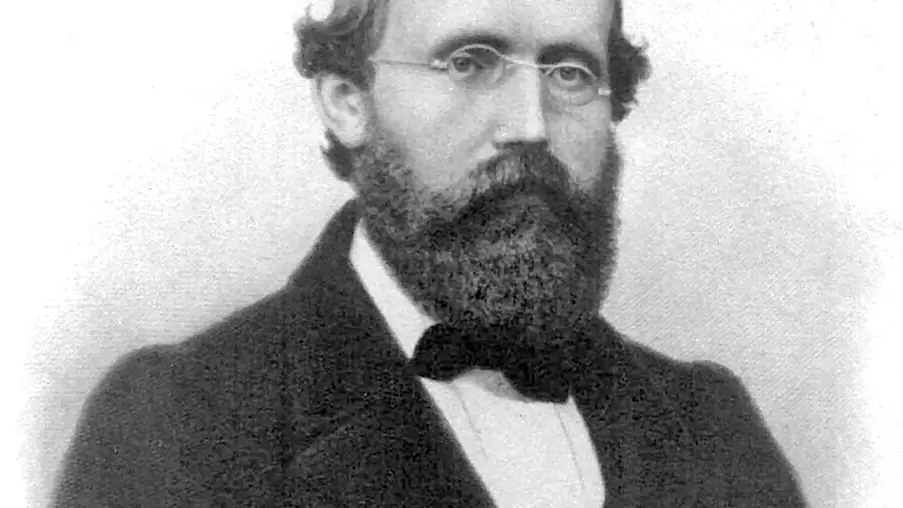
“250,000+ pages was a joke guys!, I find big number extremely hilarious.”
That’s Levent Alpöge, the Anthropic mathematician who says he and the AI model Claude have proved the Riemann hypothesis, the 167-year-old puzzle about how prime numbers are spread out that has beaten the best minds in maths since 1859. It comes with a $1 million prize.
When he released his proof on 20 November, he put it out as code in Lean, a programming language that lets computers check maths line by line. In a footnote to his short accompanying note, he mentioned that he had “amused” himself and that a written-out version had hit “250,000+ pages”. He decided it would be inappropriate to publish that.
The world, understandably, fixated on the quarter of a million pages. Headlines followed. WIRED reported he’d called the text a “travesty of slop”.
So late on Monday he posted on X under the heading “Stupid things I did”. The number, he explained, was a joke, and he had tried to signal it with the absurd pedantry of the main theorem, which opens by pointing out that the real numbers are totally ordered. “People ran with it unfortunately,” he wrote. He also admitted the Lean code “is full of garbage obviously, but compiles”.
There is a twist. When someone accused him of making the number up, he insisted the pages were real: AI tools can blow a proof up to ridiculous lengths. It just would have been silly to treat them as a proper write-up. A fellow mathematician estimated the real length at closer to 1,000–2,000 pages. By Tuesday afternoon, Alpöge reported: “No 250,000 isn’t funny to me anymore. It got old.”
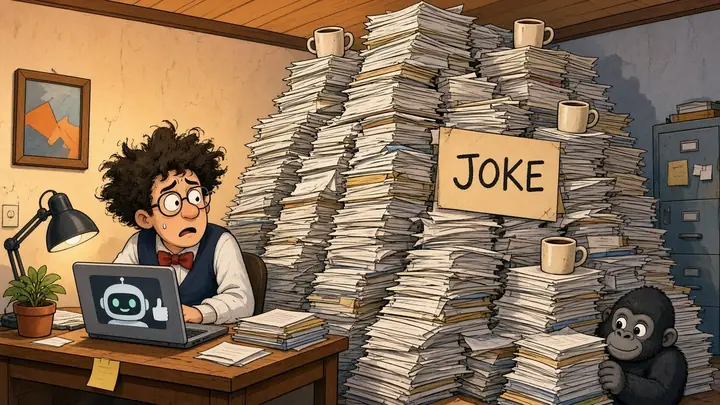 Funny AI illustration of a generic cartoon mathematician, not Levent Alpöge or any real person. (AI illustration: Gorilla Gazette / AI-generated)
So is the proof real?
The proof itself isn’t the joke. On 21 November the Lean Focused Research Organization and the Mathlib Initiative said they had full confidence that the code checks out. The Clay Mathematics Institute has moved the problem from “unsolved” to “active”, according to The Register. Under Clay’s rules a proof still has to be published and survive two years of scrutiny, and Imperial College London’s Kevin Buzzard has said nobody yet understands what it shows. Humans are now reading a proof written for a computer, slowly.
For more technology getting carried away, see the empty electric car that tried to park itself 868 times overnight.
The Gorilla Gazette view (not news, just us): We also find big number extremely hilarious. Our word count for this story is 250,000. (It isn’t.)
Sources: The Next Web, 24 November 2026; WIRED; Interesting Engineering; India Today, 24 November 2026. Alpöge’s posts were made on X on 23 and 24 November 2026. The proof has been machine-checked but has not yet been formally accepted by the mathematical community or the Clay Institute.
Image credits: Bernhard Riemann portrait, public domain via Wikimedia Commons. Cartoon: Gorilla Gazette / AI-generated.
Gorilla Gazette is not affiliated with Anthropic, the Clay Mathematics Institute or any outlet named above.