Florida's robot rabbits have caught zero Everglades pythons so far
Florida's solar-powered, heated, scented robot rabbits were meant to lure Burmese pythons out of the Everglades. More than a year on, the official python tally stands at a round zero.
In the summer of 2025, scientists in Florida unleashed a cunning plan against the Burmese pythons eating their way through the Everglades: robot rabbits. More than a year later, the scoreboard reads Robots 0, Pythons 0.
According to a University of Florida progress report obtained by the USA TODAY Network through a public records request, the team had 79 working “bionic bunnies” by this summer. Each is a stuffed toy rabbit with its insides swapped for solar-powered mechanics and a tiny heater, so it wriggles and stays warm like a real marsh rabbit. It sits in a clear pen about 15 inches (roughly 38cm) off the ground, watched by a camera that should alert a contracted python hunter the moment a snake slithers up.
Upgrades for bunnies who aren’t pulling their weight
The latest versions get a fan to waft mammal scent about, plus a second whiff of scent roughly 10ft (about 3m) away to widen the temptation zone, and the cameras have new software for faster detection.
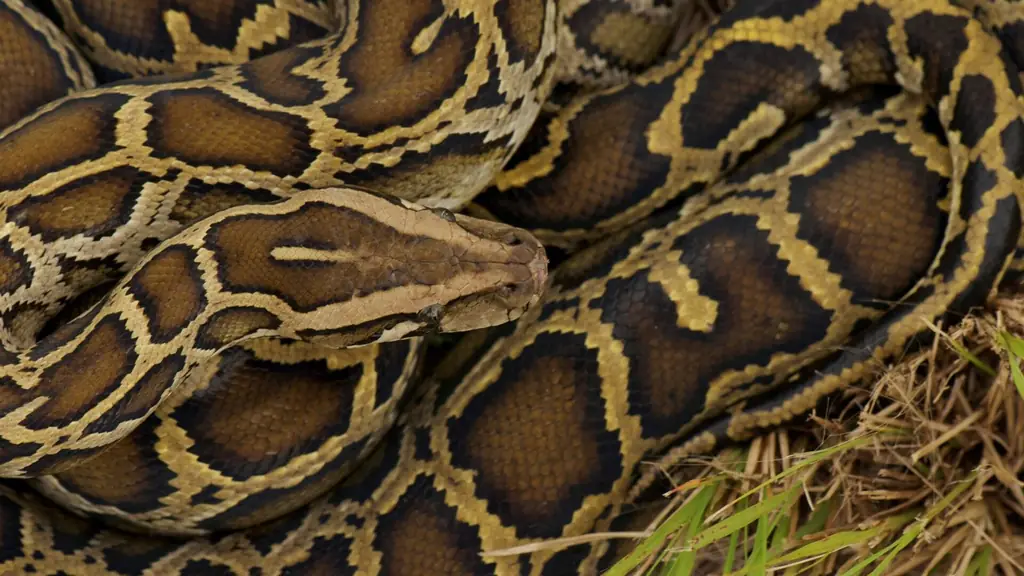
 AI illustration – not the real robot rabbits or a real python (who we assume drinks responsibly). (Gorilla Gazette / AI-generated)
The South Florida Water Management District, which has earmarked $327,535 for this and related experiments going back to 2022, says that as far as it knows the robo-rabbits haven’t produced a single python capture yet. But it understands the pilot “is still being refined”, and its own python hunters aren’t using the bunnies.
Lead researcher Professor Robert McCleery declined to give an update, saying the data was still being reviewed. Back in 2025 he admitted the team’s partners had let them trial ideas “that may sound a little crazy”.
The rabbits who came before
Earlier tests found pythons hung around pens holding live rabbits for about 80 minutes on average – but real rabbits need feeding and checking daily. A pile of dirt mixed with rabbit droppings, meanwhile, proved exactly as alluring to pythons as ordinary dirt.
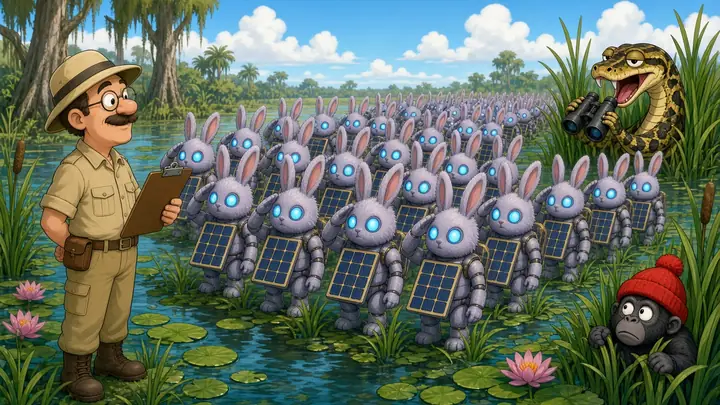 AI illustration – the bunny battalion awaits its first victory. Can you spot Gaz? #WheresGaz (Gorilla Gazette / AI-generated)
Not everyone is convinced. Conservation biologist Joe Wasilewski, who isn’t involved, suspects pythons may be clever enough to tell a mechanical bunny from a real one, but praised the team for thinking “way outside the box”. Tracked “scout” snakes, by contrast, helped the Conservancy of Southwest Florida remove 177 pythons weighing 8,080lb (about 3,665kg) this year.
When it happened: The robot rabbits were first tested in summer 2025; the progress report covers this summer, and the “no captures” news broke on 17 November 2026. NBC 6 reported in September that roughly 90 decoys were out in the field.
The Gorilla Gazette view (not news, just us): Pythons are known for being patient. Sadly for science, so, it turns out, are robot rabbits.
Sources: USA TODAY Network – Florida via Florida Times-Union (Kimberly Miller), 17 November 2026 · NBC 6 South Florida (Guamay Martell), 15 September 2026 · South Florida Water Management District, 2025